How to Tell Friends and Family That You're Going Into Long Meditation Retreat Planning
How to Create a Meditation Retreat in the Comfort of Your Home
A consummate guide to a 2-twenty-four hours custom recharge of your mind and spirit

Why on earth would anybody want to retreat even more, in times when social distancing is the norm? While the mere term itself implies withdrawal and isolation, the final weeks, ironically, have been a time of intense connection for me.
I was constantly on the phone with friends and family member s I haven't spoken to in months. I checked the news round the clock, from various countries and sources. My social feeds were on burn. I was on Zoom calls with 5 people at in one case and even got drunk on my "night out" on the balcony in the class of a very intense Skype conversation.
While it had its upsides, the reason I found myself on my cocky-made two-mean solar day isolation from isolation was because of the downsides: a feeling of extreme overwhelm, and paradoxically, complete social exhaustion.
Between the urgent itch to cheque on my grandma every two days, the need to keep in touch with everyone so as to "not lose bear on," and staying on peak of current events to "know what'due south going on," I completely forgot to take intendance of one affair: my own thoughts and feelings. While my body was indeed withdrawn, inside, my head was about to explode from all the input.
Ironically, 1 of my canceled plans was a x-day silent Vipassana meditation retreat. I decided what I needed about was a self-directed retreat that could be a substitution for that.
I one time heard the saying, "When the student is ready, the teacher will announced." This is what I experienced firsthand when I serendipitously stumbled on psychologist Tara Brach's guide to design your own home retreat.
Profoundly encouraged and inspired by it, I gathered all my experience from my last few years of meditation practice, added my noesis from years of self-exploration and the cocky-study of Buddhism, and created my own two-twenty-four hour period meditation retreat.
How Your Custom Meditation Retreat Tin Do good You lot
The holistic benefits of meditation
First of all, it's important to note I regard Buddhism as a philosophy, not a faith, and I conduct meditation equally a secular practice that'south backed by 2,500 years of Buddhism, as well equally mod science.
According to the Greater Proficient Scientific discipline Center of the UC Berkeley, meditation sharpens your attention, can increment your resiliency to stress and your capacity for compassion, can have a positive impact on your relationships, and can even improve your physical health, among other benefits.
I've also personally experienced the powerful and positive effects of meditation — it helps me deal with my anxiety and impostor syndrome and teaches me to not take my negative thoughts and emotions too seriously. I aspect a great deal of my controlling capacity and the ability to motion forward even when I'one thousand doubtful to the steady practice of meditation.
I practice mindfulness meditation, and this is also what I did during my two-day retreat. Since this isn't a guide on how to meditate but on how to create favorable circumstances for it, I won't go into the details of the practice itself.
Notwithstanding, here are a few helpful resources to put you on rail:
- Meditation apps, like Calm, Headspace, or Insight Timer, are wonderful resources if you lot prefer guided meditations. If yous're new to meditation, this is what I recommend.
- Psychologist Tara Brach's RAIN method (recognize, allow, investigate, nurture) is what helped me bring construction into my mindfulness do
- "Meditation Tips for a Lifetime of Practice": The best guide and introduction to several types of meditation I've come up across is this ane by Tasshin Fogleman
You don't have to be an gorging, experienced meditator to design your own meditation retreat. My usual meditation practice consists of 15-thirty minutes daily, and since I'k human, I skip days more often than I'd like to admit. In my suggestions for the preparation and the daily schedule, I'll depict multiple ways to pattern a beneficial retreat for yourself, regardless of your level.
What meditation within the framework of a retreat can do
A grouping of psychologists take examined the benign effects of traditional meditation retreats and institute they can be largely effective in reducing depression, anxiety, and stress and in improving the quality of life of participants.
While I haven't come beyond scientific studies for self-designed habitation retreats, I've experienced similar results. While I wouldn't go so far every bit to say my abode retreat improved my overall quality of life, I can attest to significantly lower stress and anxiety levels, lasting for weeks.
What's more than important, however, is the alter in my perceived ability to deal with ascension stress and anxiety levels. The whole point of mindfulness meditation is to notice, observe, and take all thoughts and feelings that arise without acting on them.
Andy Puddicombe, founder of the meditation app Headspace, puts this nicely in this video: He compares the mind to a trafficky highway, where the passing cars stand for the thoughts and feelings. Instead of being an angry driver on the highway, mindfulness meditation helps usa to become a neutral observer of this highway — ane who knows all cars will eventually pass.
While a daily meditation practice of 15-30 minutes also helps to attain that mindset and to become more neutral toward what goes on in our heads, information technology's a tiresome procedure that requires a lot of patience. The lack of quick results and instant gratification makes it often hard to stay at it.
Meditating for several hours a 24-hour interval for two days in a row helped me to take a glance at the inner peace and at-home more gorging meditators usually talk well-nigh. It showed me what my mind is capable of with a lot of do. What's more, it helped me bring this awareness of thoughts into my everyday life, away from the meditation-cushion. In the stop, as the writer and Buddhist teacher Sharon Salzberg put it:
We don't meditate to become better at meditating, we meditate to go amend at life. — Sharon Salzberg
How to Design Your Meditation Retreat
Tara Brach'due south guide to designing your home retreat as well equally the schedule of my rain-checked x-twenty-four hours Vipassana grade both helped me a lot when I organized my own retreat.
From the thought to the outset, roughly a week went by. During this time I realized a whole cord of things I needed to recollect about and prepare: I don't live lonely — tin I yet do the retreat? What volition I eat? What volition I practice all twenty-four hours — I can't meditate for ten hours past myself!? Why two days — tin I only do one, or should I go for more? What if a client calls?
These are all questions I'll reply in the paragraphs below.
The duration
First, I needed to decide how long my retreat should final. What I aimed for was a balance between touch on and feasibility: I wanted to feel the benefits but give myself a chance to pull information technology through.
My determination to go with 2 days was based more on my gut than whatsoever evidence. Two days seemed like a serious-enough delivery and as well reasonable due to my previous meditation experience. I figured I could prolong if later on ii days if I felt I needed more.
It worked well for me, and then if you lot tin identify with my regular but rather moderate meditation experience, this might piece of work well for you, likewise.
Also, two days is the length of a weekend, so it's a fourth dimension frame for which almost everyone should have the ability to totally disconnect from job obligations, even if you aren't self-employed.
The schedule
The daily schedule of the conventional 10-day Vipassana retreat I was to attend is pretty straightforward:
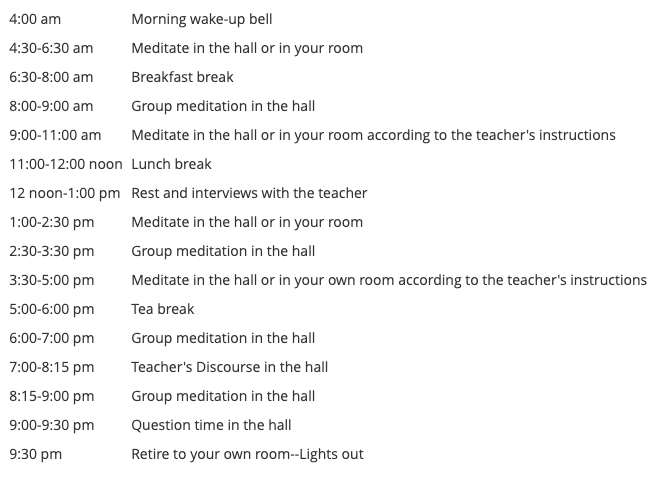
Note this is a timetable for meditation under supervision, in a grouping. Information technology's a meditation kick camp, so to say, which comes with a strict noble-silence (read: no-speaking) policy.
While the schedule served every bit my anchor and helped me encounter what a day at a meditation retreat tin look like, I made several adjustments to it.
What I aimed for was a daily schedule that respects my predisposition (e.g., natural wake-upwardly and sleep times). I besides wanted something that pushed me further in my meditation practice and out of my comfort zone while remaining rewarding (i.due east., something I'd genuinely look frontward to).
As Amanda E. White, LPC put information technology,
"True self-care involves balancing ii seemingly contrary ethics: radical self-compassion and accountability."
In the cease, what y'all desire is a schedule yous can pull through. I had no other expectations toward myself and my retreat than to stick to my well-thought-out schedule — to be answerable to myself.
When you design your schedule, I tin recommend a similar residuum: a well-wrought timetable you can reasonably stick to.
Wake-up time
Since I'1000 a night owl, I fix my wake-upwards time to 8 a.m., which is early merely reasonable for me.
On the above Vipassana schedule, you correctly meet the wake-upwards bell is 4 whole hours earlier. While I believe I can castor my teeth at 4 a.m. under peer pressure, to fix a wake-upward time significantly earlier than I'm used to when lonely would practise nix more than slim down my chances at sticking to my plan.
Talking most balance, I recommend the aforementioned for you: Choose an early but reasonable wake-upwardly time for y'all.
The activities
While I talk virtually a meditation retreat, information technology doesn't mean meditation is the but matter you're allowed to do. I trust I'm able to meditate for days and do nothing else if I'k under guidance and am among people who practise the same. At the same time, I know information technology'd be arduous for me to do it alone.
To decide which activities to pursue and for how long, I did a quick brainstorm session: I wrote downwardly what activities came to mind that would make full my platonic retreat.
What I aimed for was a mix of (1) physical movement, (2) mental stimulation, (3) fresh air, and, of course, (four) meditation. All of these are proven to enhance your psychological and/or physical health.
Inside these components, there'south a vast array of activities suitable for a solo-retreat.
In the end, I settled for yoga, short walks in nature, reading, and listening to Dharma talks (source: here) — components that constitute a healthy, counterbalanced day, after which I'd experience well.
The activities you choose can exist entirely different from mine. Still, I recommend they both feel good and are practiced for you (northward.b., these don't always overlap!).
Here are a few further ideas from my shortlist:
- Replace yoga with a run and thus connect physical movement with fresh air
- Any kind of other abode conditioning apart from yoga
- Replace or mix Dharma talks with TED talks, podcasts, etc. This is especially suitable if you lot'd rather aim for intellectual stimulation over spiritual stimulation.
- Replace reading with some other hobby (cartoon, coloring volume, etc.)
In the cease, this is what my schedule looked similar:
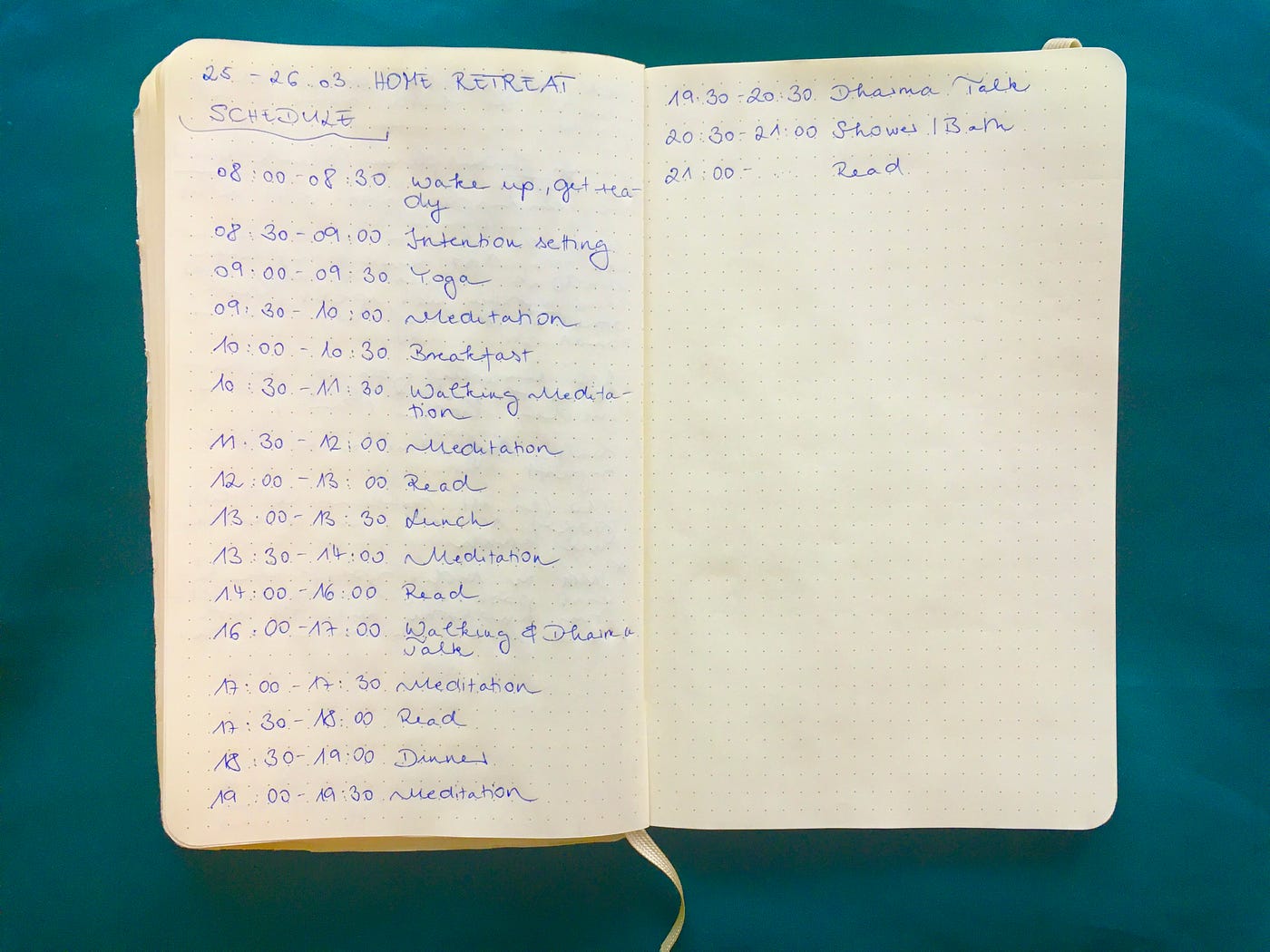
As for the length of each meditation session, I roughly followed Tara Brach's guidelines:
"For beginners, schedule several 20–xxx min sitting periods in the morning, and several periods in the afternoon and evening. Have each sitting period alternate with a 20–xxx minute period of walking meditation, yoga, Tai Chi or repose mindful walks outdoors, if available. […] If you lot are more experienced, brand your sittings 45–hr, with a menstruum of mindful movement between each sitting."
Since this was the first fourth dimension I was near to meditate several times a day, I settled for 30-minute sessions.
The food
Proper planning of your retreat also involves thinking about practicalities, like food. As you can see, cooking wasn't on my list of activities, and then I needed to call back of my meals in advance.
I followed two guidelines of Buddhist pedagogy:
- Out of personal conviction and due to the fact that violence in whatever class, under whatever pretext whatever, goes confronting Buddhist guidelines, I decided to eat a vegan diet during the retreat (I'm vegetarian)
- Sloth and torpor are one of the v hindrances to meditation in Buddhist education, and a packed tum profoundly facilitates physical languor — then I went for low-cal meals
To make this as easy and feasible equally possible, this is what I did the mean solar day before my retreat:
- I bought vegan muesli and soy milk for breakfast
- I ordered vegan Indian food for lunch that'd terminal for two days
- I prepared a big batch of fresh salad with a tahini-olive-oil-soy-sauce-lemon dressing.
Any diet you opt for, make sure you prepare or order it the twenty-four hours earlier, unless you want to make mindful cooking one of your activities. If and then, brand sure to accept the ingredients ready.
The rules
To pick up on the correct residuum between self-compassion and accountability to self, yous demand to prepare rules. Without rules, you run the danger of spending ii days with Netflix and your phone on the couch nether the guise of beingness on retreat.
These were my rules:
Rule #ane: Strict no-internet/phone/laptop policy:
I of the main reasons I did the retreat in the first place was considering of social overwhelm and news anxiety. I'm sure I'k non the only one these days.
In Austria, where I live, people made 80% more than phone calls than usual at the cease of March (112,000,000 minutes per solar day countrywide).
Studies (similar this 1, this 1, or this one) show negative news, screen fourth dimension, and social media cause or amplify personal worries, anxiety symptoms, depression, and psychological distress.
Since the calming and recharge of my heed and spirit was why I had the idea of the retreat in the first place, to stay away from all the net and all kinds of devices was my top priority.
I highly recommend you lot practise the aforementioned, as it'll help y'all see things more objectively and bring better concentration to your retreat and practice.
Rule #2: As trivial talk as possible
The Vipassana retreat I wanted to attend cultivates a strict no-speaking policy throughout the ten days. This stems from Buddhism's Noble Eightfold Path (the practices which can lead ane to experience nirvana). The concept of correct speech is the third division of this path.
According to Walpola Rahula, who was a Buddhist monk and a professor of history and faith at the Northwestern University,
"Right speech means […] [o]ne should not speak carelessly: speech should be at the right time and place. If 1 cannot say something useful, ane should go on 'noble silence.'"
Since I live with my partner on 50 sqm and am all for feasibility, my rule was, therefore, to speak equally trivial equally possible. This prevented my retreat from becoming awkward, strained, or cool, and it nevertheless immune me the chance to practise noble silence.
Rule #3: Keep at information technology
I fabricated a vow to myself to follow through with what I set up out to do and to avoid the all-or-nil mentality at the same fourth dimension.
In the finish, I allowed myself a few breaks. Therefore, I finished 1.5 hours later than my schedule dictated. Also, I fell asleep during ii of my reading sessions. However, this wasn't a problem at all. My promise to myself was to keep at it and jump back if something came in-between.
Be gentle with yourself. You can't know how viable your schedule is before you've done information technology. If things accept longer, take information technology. If you become idle, accept that likewise, and gently motion forward. This isn't a race or a challenge. It'south a exercise of accountability and cocky-care.
Inevitable Hindrances
Here comes the hard truth: Even if you follow all of the tips above — have a feasible schedule, take prepped food in the fridge, and accept made the vow to stay away from the internet — you lot'll be tempted to break these rules or even to entirely quit the retreat halfway through.
The reason is our stone-anile survival instincts aren't fabricated for internal and external stillness. and our minds are constantly looking for things to do, to improve, or to preclude. Being even so with the present moment is just not what kept united states alive in the caves when the saber-toothed tiger attacked.
Buddhism defines 5 main reasons (hindrances) that aggressively prevent our minds from staying present, sitting all the same, and meditating:
- Sensual desires (want): All the boo-boos of your body, from hunger to sexual desire to the urge to stretch your legs
- Hate, acrimony, and ill will: These can be directed at yourself, someone else, or the structure site next door that doesn't permit you to meditate
- Agitation, restlessness, worry: The feeling everything will fall apart unless y'all do something about information technology, right at present. All your anxious thoughts and fears fall into this category.
- Boredom: sloth, torpor, languor, daze: The feeling of "I'd rather practise something else, like telephone call a friend or check Instagram"
- Uncertainty: Doubt volition tell yous it's total nonsense to do this retreat in the outset place
Knowing the name of these bad boys makes information technology easier to bargain with them one time they show up. They testify up for everyone differently, all to different extents, but they're the about reliable companions of whatever meditation practice, as they're in some grade always there.
Here's how it usually goes for me when I meditate and how it went on my retreat:
My strongest hindrance is restlessness (paired with worry), quickly followed by boredom.
My restlessness
If I find information technology closely, I tin experience the restlessness in my prickling fingers and toes whenever I sit down down to meditate. I grew up with the conviction only those who do something are worth something. Merely to sit doesn't count every bit a meaningful activeness, so my mind rebels every time to preclude me from the feeling of uselessness.
By at present, I'chiliad somewhat used to the tingling and was prepared for restlessness to evidence upward. I more than often than not tin resist the temptation to run effectually in circles and have found a way to run across the hindrance with pity.
What I did on the retreat was thank my restlessness for wanting to accept care of me, and, at the same time, I reassured myself it'due south safe to merely sit for ii days. I observed the tingling and didn't human activity on information technology.
My worry
My feeling of uselessness sometimes becomes bottomless. When restlessness feels ignored, information technology tends to throw everything I ever did wrong into my face, simply to evidence me I don't deserve to just sit here similar everything's fine.
It might sound mundane, but, again, all I can practise is to sit it out and not run away from these thoughts and throw myself into distracting activities. Through a lot of reading and cocky-observation practice, I (at to the lowest degree, in theory) learned that pain is normal and inevitable, and the best way to deal with information technology is to let it to be.
"In any case, the signal is not to endeavour to get rid of thoughts, but rather to see their truthful nature. Thoughts will run us around in circles if nosotros buy into them, but really they are like dream images. They are similar an illusion — not really all that solid. They are, as nosotros say, just thinking."
— Pema Chödrön
My colorlessness
Boredom was a harder i considering I didn't anticipate it. It showed off at the second function of twenty-four hours i, once the novel experience of being on a home retreat wore off.
For me, boredom manifests in thoughts similar, "Jeez, how much longer will this session last? I definitely tin't practise another ane."
The real low bespeak happened on the morning of twenty-four hour period two. When I woke upwards at 8 a.m., tired, and knew I had 5+ hours of meditation in front end of me. I felt like cutting the day in half and finishing at apex.
What helped me, again, was to stick to my original promise and sit down for the offset meditation session. Once I was meditating, I could meet boredom for what it was: a feeling only like any other. I acknowledged it, observed the sensations in my breadbasket that told me to do something more fun today, and carried on with the practice.
What about you lot?
Note these examples are uniquely my own experience, and you lot might not encounter any issues with boredom, worry, or restlessness.
However, you're likely to encounter some of the higher up hindrances. Here's what yous can do:
- Accept there will be thoughts and feelings that'll want to forbid you lot from going through with your plans
- Think about which of the above hindrances are almost likely to show upwards for y'all in advance — you lot know yourself best
- Once you lot come across a hindering feeling during your retreat, endeavour to see it for what it is: a hindering feeling — not more and not less. These aren't real reasons to cut it off.
- Be compassionate toward yourself. Thank your thoughts and feelings for wanting to have intendance of you. Run into, they're oftentimes like a child throwing a tantrum. Just similar yous wouldn't yell at the child, don't yell at yourself either.
While I managed to become through with the schedule I set, when I started to meditate, I had several episodes that I called off afterward a few minutes. They were either too painful or too deadening. It's OK and normal if this happens to y'all. It doesn't hateful yous've failed or can't meditate or shouldn't practise a retreat.
The empathetic thing to practice is to have it and endeavour to sit dorsum on the cushion whenever you tin can. All the above hindrances are an inevitable function of life and such a retreat shows this very clearly. While pain is inevitable, suffering is optional. We only really endure when we tin can't accept the reality nosotros face.
Endeavor to see everything that comes along your style as function of the process. Fifty-fifty if information technology's difficult and even if you can't become through it at that moment. If yous approach your retreat with an open mindset toward everything that can come up, y'all've already freed yourself from a large potential burden.
Every bit Pema Chödrön put it:
"The nigh fundamental aggression to ourselves, the most primal impairment we can do to ourselves, is to remain ignorant by not having the backbone and the respect to wait at ourselves honestly and gently."
Further Tips
Apart from what I described above, here are the things that further helped me go through with my retreat:
Tip #1: Prepare an intention
As you lot tin run across on my timetable above, I started the days by setting an intention. I lit a candle and took a few notes in my journal almost why I was doing this retreat in the commencement identify. This helped me set the mood and served every bit a reminder throughout the solar day when things got difficult.
You tin can go with one or several intentions. Examples for intentions are the cultivation of inner peace, credence of things as they come, or the deepening of self-love. In that location are no rules only to make the intention relevant to yourself.
It's important, however, to non confuse your intention setting with goal setting. Goals are quantifiable time to come-oriented targets leap to a deadline that signal the nowadays isn't good plenty. As Marta Brzosko highlights in her guide to intention setting on a spiritual journey, intention-setting is more near the how than the what.
A good example is the intention of deepening self-dear where she suggests to inquire, "How tin can I codify my intention so that it'southward possible to enact regardless of how I'm feeling?"
Here, yous could make up one's mind to respond with self-love and speak to yourself with kindness, fifty-fifty if y'all feel bad, unworthy, or aback.
Tip #two: Reward yourself
As I wrote in a higher place, a meditation retreat means work. To sit in one place several times a solar day with cypher but your thoughts tin can be challenging both emotionally and physically. Give thanks yourself for doing this — for taking the fourth dimension to testify upwardly for yourself.
My reward was a long hot bath later on both days while I listened to ambient music. For you, it tin be chocolate or your favorite audiobook. Again, this is something you need to brand relevant to no one simply yous — a tiny gesture that honors your practice and effort.
Rewards look dissimilar from person to person, and then it's hard to give suggestions. The only dominion, again, is to exercise something that feels good and is good for y'all (i.due east., a cigarette or beer doesn't count every bit an advisable advantage).
Tip #3: Work with what yous have
I'm sure for many people — like for me — the timing, location, or general circumstances aren't perfect for a retreat. However, exist honest with yourself. Were the last months perfect? Volition the next half dozen months be? What I want to get at is: Work with what you accept, and avoid the all-or-nothing mentality.
Sure, a silent retreat isn't platonic if you don't live lone. Yet — it'south doable. Set your own rules, and keep talking to a minimum.
Perhaps you lot don't accept a whole room for yourself to exercise this — in this case, option a corner, and effort to isolate it with cushions.
Peradventure you lot're self-employed and feel it all collapses if you lot don't cheque your emails for a day. Hither, an out-of-office message might help.
I didn't make these scenarios up — I alive on 50 sqm with my boyfriend and am self-employed. I'thou certain my retreat wasn't perfect, just residue bodacious it was still a wonderful, enlightening experience yous can have also, despite any perceived obstacles.
Final Thoughts
My two-day retreat was the most rewarding and grounding experience I've washed in the by weeks.
Nonetheless, I'd lie if I said it was easy and felt similar a skillful holiday weekend because information technology didn't. Meditation is a powerful tool that points you toward hard — oftentimes shameful or anxiety-inducing — thoughts and feelings which our defense mechanisms otherwise tend to avoid by keeping busy.
When information technology's only you and your head for a full solar day or two, in that location's nowhere else to await, which tin be hard, sad, exhausting, and, frankly, also boring. We're and then used to doing something that our body and mind insubordinate like a child when forced to sit however.
Three things were crucial for me to get through the difficult moments of my retreat:
- Accepting myself, my thoughts, my and feelings and speaking kindly to myself throughout (equally described in the Hindrances section)
- Reminding myself of the intention I assail both mornings
- My predefined rule to keep at it, no thing what. I seem to be accountable to myself every bit an act of cocky-love and self-care. To frame it this way helped me stay focused.
Finally, I'd like to bring Buddhist teacher Ethan Nichtern's words to your attention. He wrote,
"Meditation is one of the all-time ways to make sure you are not socially distancing from yourself."
May this domicile-retreat feel be as rewarding and insightful for you as it was for me.
Source: https://betterhumans.pub/how-to-create-a-meditation-retreat-in-the-comfort-of-your-home-f3fe8555ddf9

Post a Comment for "How to Tell Friends and Family That You're Going Into Long Meditation Retreat Planning"